A plain guide to melatonin with NIH sources: what the hormone does, how to read the amount on a supplement label, why label accuracy matters, the mild side effects and who should check with a doctor first.

Editorial disclosure: theyusleepguide.com is an independent guide and is not the manufacturer, distributor or seller of Yu Sleep. It contains affiliate links, and we may earn a commission if you purchase through them, at no extra cost to you. These statements have not been evaluated by the Food and Drug Administration. Yu Sleep is not intended to diagnose, treat, cure, or prevent any disease. Consult a healthcare professional before use.
NCCIH describes melatonin as a hormone that your brain produces in response to darkness. Light at night can block its production. Melatonin supplements are sold in many strengths, and a product's label tells you how much a serving is meant to contain.
Your own melatonin rises when it gets dark. That is why bright screens and lights late in the evening work against it.
NCCIH: MelatoninNCCIH says melatonin may help in some situations where the timing of sleep is out of step, and that for longer-running sleep problems there is not enough strong evidence to recommend it.
NCCIH: MelatoninShort-term use of melatonin supplements appears to be safe for most people, according to NCCIH. Information on long-term safety is lacking.
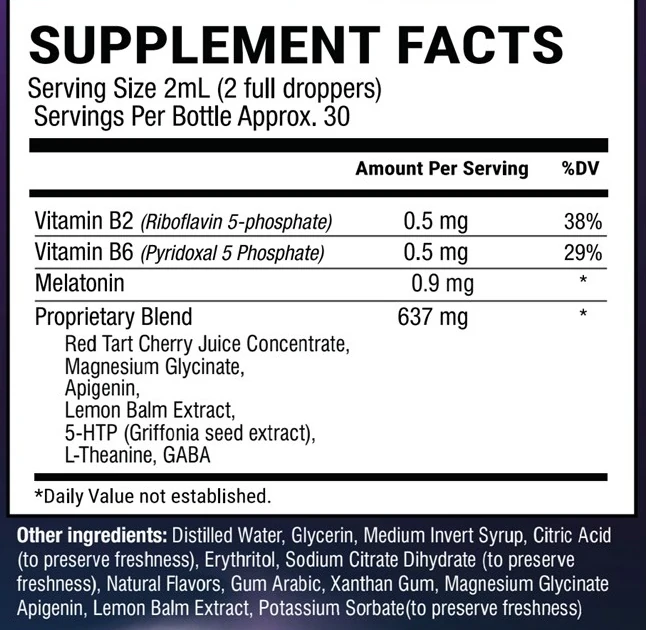
NCCIH: MelatoninA label states melatonin in milligrams per serving, and 0.9 mg is less than one milligram. Strengths differ widely between products, so compare the amount per serving, not the bottle size.
Melatonin has no Daily Value, so the percent column shows an asterisk or a dagger that leads to "Daily Value not established".
NCCIH reports a study in which, for most of the melatonin supplements tested, the amount of melatonin did not match the label, and some contained serotonin. Buying from the brand's official page and keeping the label helps you know what you have.
NCCIH: Melatonin labelsIn short-term adult studies, NCCIH lists headache, dizziness, nausea and sleepiness. Melatonin may stay active longer in older people and cause daytime drowsiness.
NCCIH: Melatonin safetyIf any of these applies to you, check with a doctor first. NIH ODS: Dietary supplements, what you need to know
Yu Sleep lists melatonin at 0.9 mg in each 2 mL serving, taken under the tongue 30 minutes before bed, alongside 0.5 mg each of vitamins B2 and B6 and a 637 mg blend that includes red tart cherry juice concentrate, itself a natural source of melatonin. The full panel is on the Yu Sleep ingredients page.
A hormone your brain produces in response to darkness, according to NCCIH. Light at night can block its production.
It is less than one milligram per serving. Strengths differ widely between products, so always go by the amount per serving printed on the label.
NCCIH says short-term use appears to be safe for most people, with mild side effects such as headache, dizziness, nausea and sleepiness. Information on long-term use is lacking.
Sleepiness is one of the side effects NCCIH lists, and it notes that melatonin may stay active longer in older people and cause daytime drowsiness.
Not always. NCCIH reports a study in which most melatonin supplements tested did not match their labels, and some contained serotonin.
0.9 mg per 2 mL serving.
Yu Sleep lists 0.9 mg of melatonin per 2 mL serving with vitamins B2 and B6 and a 637 mg blend. Orders from the official page come with a 60-day refund policy. Details are on the Yu Sleep ingredients page.
Open the Yu Sleep Order Page